HiC4D-SPOT: a spatiotemporal outlier detection tool for Hi-C data
An unsupervised deep-learning tool that flags exactly where and when the 3D folding of the genome goes wrong across time.
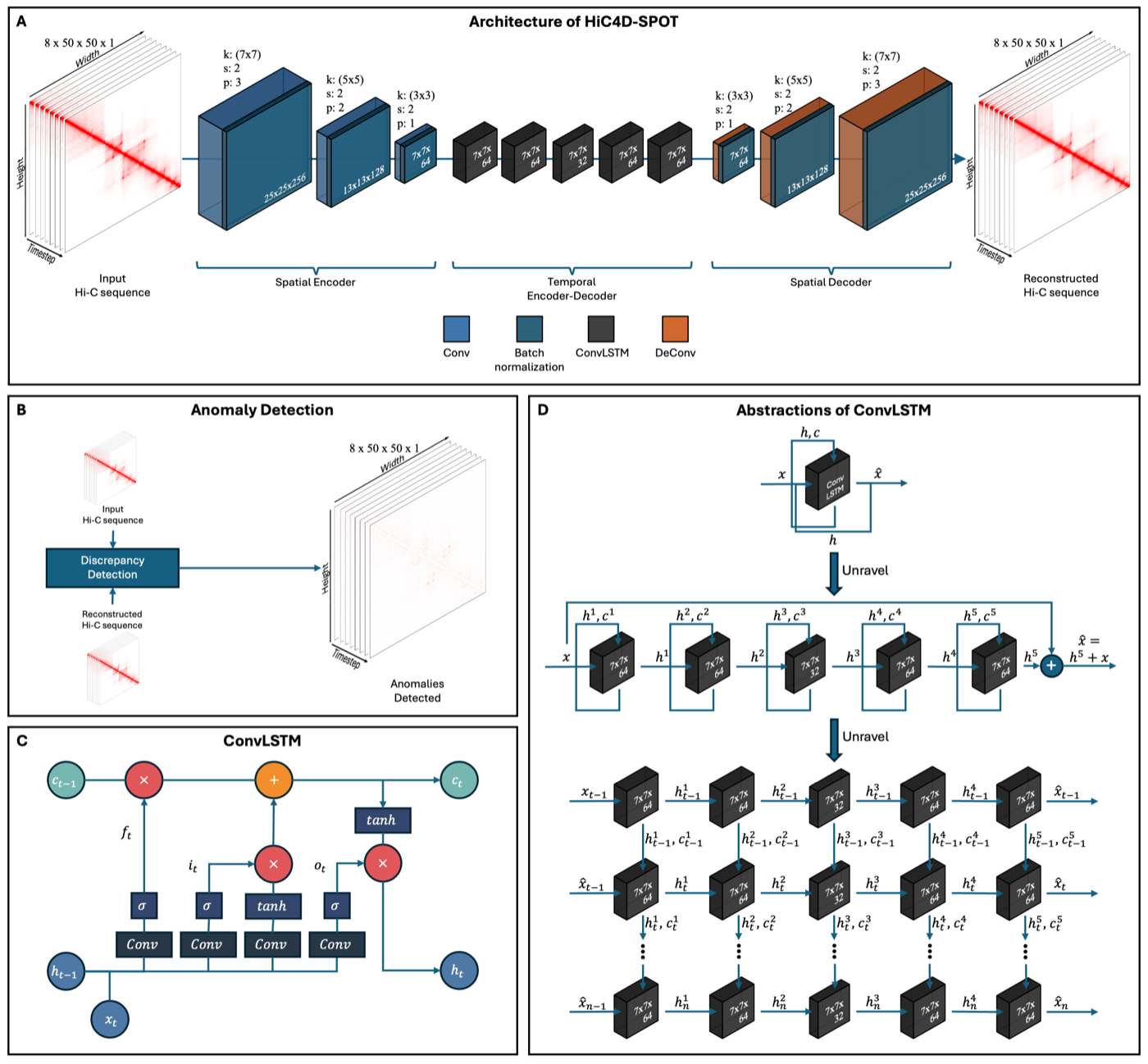
Hi-C anomaly detection across space and time
Abstract
The 3D organization of chromatin is essential for cellular processes including transcriptional regulation, genome integrity, chromatin accessibility, and higher-order nuclear architecture. Detecting anomalous chromatin interactions in spatiotemporal Hi-C data remains a significant challenge. HiC4D-SPOT is an unsupervised deep-learning framework that models chromatin dynamics using a ConvLSTM-based autoencoder to identify structural anomalies. It achieves high reconstruction fidelity (Pearson and Spearman correlation of 0.9) while accurately detecting deviations linked to temporal inconsistencies, TAD and loop perturbations, and significant chromatin remodeling, including HERV-H boundary weakening during cardiomyocyte differentiation and cohesin-mediated loop loss and recovery, aligning with experimentally observed events.
Authors
Shrestha B, Wang Z
Briefings in Bioinformatics · 26(4), bbaf341 · Oxford University Press
How to cite
@article{shrestha2025hic4dspot,
  title   = {HiC4D-SPOT: a spatiotemporal outlier detection tool for Hi-C data},
  author  = {Shrestha, Bishal and Wang, Zheng},
  journal = {Briefings in Bioinformatics},
  volume  = {26},
  number  = {4},
  pages   = {bbaf341},
  year    = {2025},
  doi     = {10.1093/bib/bbaf341}
}More at the genome scale
- SCW: building the whole-genome 3D structures based on extremely sparse single-cell Hi-C dataBMC Bioinformatics · 2026